










In the fast-paced digital world of today, companies are always exploring new ways to reach their audience, personalize experiences, and convert. Introduce the marketing chatbot, a robust, little-understood technology that’s rapidly revolutionizing the way businesses interact with their customers. Every successful business today needs a dynamic marketing chatbot.
Clarity is the glue that creates a solid user experience away from a clunky rule-based chatbot; clarity is what gives your visitors confidence in your chatbot and can guide your users into leaving their response.
This ultimate guide will help you take a deep dive into your chatbots for marketing campaigns, discover massive possibilities and use cases, and understand why they’re transforming into a crucial tool for businesses, big and small. The strategic deployment of chatbots for marketing is key. We will learn how smart conversational agents are not only a fad, but a big turn for chatbots in digital marketing.
The Birth of Chatbot Marketing
The age of immediacy is here and brought to us courtesy of the digital age. They want answers on the spot without having to wait, and they expect personal service all 24 hours of the day. Traditional marketing vehicles, though still effective, typically fail to deliver on these expectations at scale. This is what chatbot marketing does best.
Think of a potential customer who visits your site at 2 AM, wondering about a product. Without a marketing chatbot, they would probably leave their interest un-nurtured. However, with a chatbot, they immediately receive responses, product suggestions, and access to guided help in order to potentially complete a transaction. The ability to create automated customer interactions 24/7 is a game-changer. This seamless automated customer interaction is key to modern success.
What’s more, there are so many messaging apps around that people are becoming more comfortable with chatting. By including chatbots in digital marketing campaigns, businesses are meeting their customers where they are engaged with the content, making it a natural, effortless engagement.
The chatbot marketing market is booming and is forecast to hit $46.64 billion by 2029, yet 83% of businesses using AI suggest they’re getting an ROI.
These figures highlight how chatbots for marketing are really paying off and resonating across the spectrum.
Also read:– DeepSeek Vs ChatGPT
How To Use Chatbots For Marketing?
Adopting chatbots in digital marketing has to be strategic. The following is a full-fledged explanation of how to effectively market using chatbots:
Define Clear Objectives
Before you develop or embed a chatbot, understand its main goal. Do you want it to:
- Generate leads?
- Provide customer support?
- Automate sales?
- Gather feedback?
- Offer personalized recommendations?
Having specific and measurable goals will help you shape your chatbot’s chatflow and, in the end, your overall strategy. If your goal is to get leads, for example, your lead generation chatbot will be centred on the kind of questions that would qualify prospects. A well-designed lead generation chatbot is vital for sales funnels.
Choose the Right Platform
There are plenty of conversation platforms available on the market, from simple WYSIWYG type builders all the way up to fancy AI-based stuff. Consider factors like:
- Integration potential: Does it integrate with your CRM and your email marketing software, as well as other tools you absolutely need connected to it?
- NLP and AI features: “Is it able to comprehend complex questions and give human-like replies to them?” For companies that are in experimentation mode or have small budgets, an AI chatbot free online software can offer a good stepping stone. There are a lot of platforms that have free plans with the most basic features.
- Scalability: Is the platform scalable with the way your business grows?
- User experience: Is it intuitive for your marketing team?
Popular choices might be one of the platforms that offer an AI chatbot free online for basic use, letting businesses take their first step into AI without spending a vast amount of money. For advanced needs, consider an AI chatbot for small business solutions.
Design Intuitive Conversational Flows
And this is where the magic happens. The effectiveness of your chatbot depends on how well it can have smart, useful conversations.
Welcome users warmly by introducing the chatbot and its purpose right away. Anticipate their needs by identifying common questions and scenarios. Use simple, clear language to avoid jargon and keep your messages brief. Offer choices through buttons or quick replies to guide users. Have backup options available to help users if the chatbot doesn’t understand a question, directing them to human help or an FAQ. Finally, create a consistent personality and voice for the chatbot that reflects your brand.
Works With Your Favorite Marketing Stack
The way to get the most out of chatbots for marketing is to easily integrate them with your CRM, email marketing platform, and other sales tools. This allows for:
Lead nurturing automation
Leads that are captured via that lead generation chatbot will also be automatically pushed to your CRM and nurtured further using email sequences.
Personalized follow-up
Data collected by the chatbot can be used to drive personalized email campaigns or sales outreach.
Data sync it
Centralize all your customer interaction data for a complete view.
Leverage AI for Smarter Interactions

Artificial Intelligence (AI), known as Natural Language Processing (NLP) and Machine Learning (ML), is used as the technology behind today’s chatbots in digital marketing.
Sentiment Analysis
AI-driven chatbots are able to identify positive or negative sentiment from what a user has said, providing a more empathetic response.
Contextual Comprehension
They can hold the gist of the mill context throughout a dialogue and even a few responses.
Learning and improving
They get smarter and more accurate with each data set they handle. Try testing out these advanced elements with an AI chatbot free online.
Monitor, Analyze, and Optimize
Chatbot implementation ain’t something you just set and forget. Continuously track analytics to make sure it’s working correctly on your site:
Conversion rates
What percentage of chatbot interactions leads to a desired outcome, such as capturing a lead or completing a sale?
Chatbot Success Rate
The percentage of interactions in which the chatbot effectively meets the user’s needs and successfully resolves their inquiries or tasks.
Escalation Rates
How often does the chatbot need to refer the conversation to a human agent for additional support?
User satisfaction
Collect and evaluate user feedback on the chatbot’s performance and usability. Gather qualitative and quantitative data to identify satisfaction areas and potential improvements, analyzing patterns to enhance functionality and user experience.
Leverage these learnings to refine your conversational flows, bring adaptive responses, and optimize your chatbot marketing strategy as a whole. This continuous optimization ensures your chatbot marketing efforts yield maximum ROI.
Use Cases for Chatbots in Marketing
Let’s take a look at how marketing chatbots are leveraged in successful ways.
AI Chatbot for Small Business
Small businesses are typically resource-constrained, so being efficient is key. An AI chatbot for small businesses can even the playing field, enabling you with features that in yesteryears were restricted to big organizations. This makes an AI chatbot for a small business a powerful asset.
24/7 customer service
Manage the most common customer questions, freeing small business owners and their staff to serve customers. This is a prime example of automated customer interaction.
Lead qualification
Pre-qualify leads automatically so that sales can focus all efforts on promising prospects.
Appointment booking
Streamline appointment scheduling and rescheduling, and save time on admin.
Personalized Product Recommendations
In terms of small business e-commerce, an AI chatbot for small businesses can help direct your customers to products they may be looking for and increase the number of sales.
Collect Feedback
Follow up on customer feedback to make your products or services better. Many platforms provide free plans for AI chatbots online, so it’s easy for small businesses to try.
Enhance your knowledge:- Generative Engine Optimization vs. Search Engine Optimization
WhatsApp Marketing Chatbot
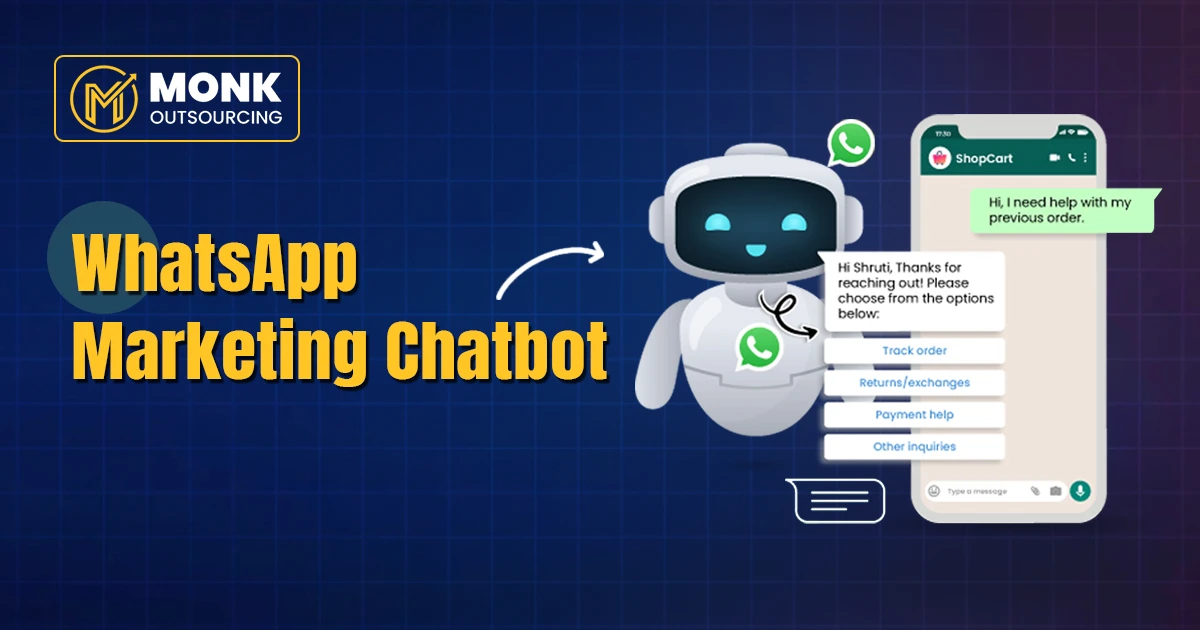
WhatsApp has many users across the world, so incorporating a WhatsApp marketing chatbot just makes business sense. This specific type of marketing chatbot is highly effective. A well-implemented WhatsApp marketing chatbot can drive significant engagement.
Direct Access: Connect with customers directly on a channel they check every day.
Offers and Announcements: Promote special offers, new products, and order status updates.
Support: Get instant support and answers to frequently asked questions directly within WhatsApp. This represents efficient automated customer interaction.
Order Processing: A few companies also use WhatsApp marketing chatbots to even place the order and get payment done.
Creating Loyalty: Personalized conversations on WhatsApp can help a business establish a stronger bond with customers. Best practices fall under the following WhatsApp business policies: receiving explicit opt-in and ensuring each message brings value.
Lead Generation Chatbot
The main purpose of a lead generation chatbot is to find, connect with, and qualify new leads. This makes it an indispensable tool for chatbots for marketing.
- Visitor engagement on website: Proactively drive conversations with visitors who express an intent (like spending time on the pricing page).
- Information collection: Gather vital information such as name, email, company, and needs using conversational forms.
- Qualification question: Grill them about the things they don’t know they need: their budget, timeline, and decision-makers involved in the purchasing process.
- Automated follow-up: Immediately share helpful content (whitepapers, case studies, etc.) or book a sales call. This is another form of automated customer interaction.
- Segment leads: Automatically leads based on how they answered you, enabling you to follow up with leads in a more personalized way. A robust lead generation chatbot streamlines the entire process.
Conclusion
The digital marketing world is always changing, and marketing chatbots are leading the charge. The advantages range from automating customer interactions and generating leads to delivering personal experiences and cutting operational costs. Marketers who eschew chatbot marketing do so at their own peril: dispensing with the use of a chatbot is simply a non-option for businesses large and small. An AI chatbot for small businesses can be a game-changer here.
By knowing the right way to market via chatbots for marketing, what platform to choose, and staying focused in the process, a world of customer connection and growth potential will be opened for your business. The future of marketing is conversational, and chatbot marketing is at the forefront of conversational marketing. Embracing chatbot marketing is essential for competitive advantage. No time to lose – get on board the conversational revolution and put the smart new technology, such as chatbots in digital marketing, to work to enhance your brand. Furthermore, consider a WhatsApp marketing chatbot for direct engagement.