







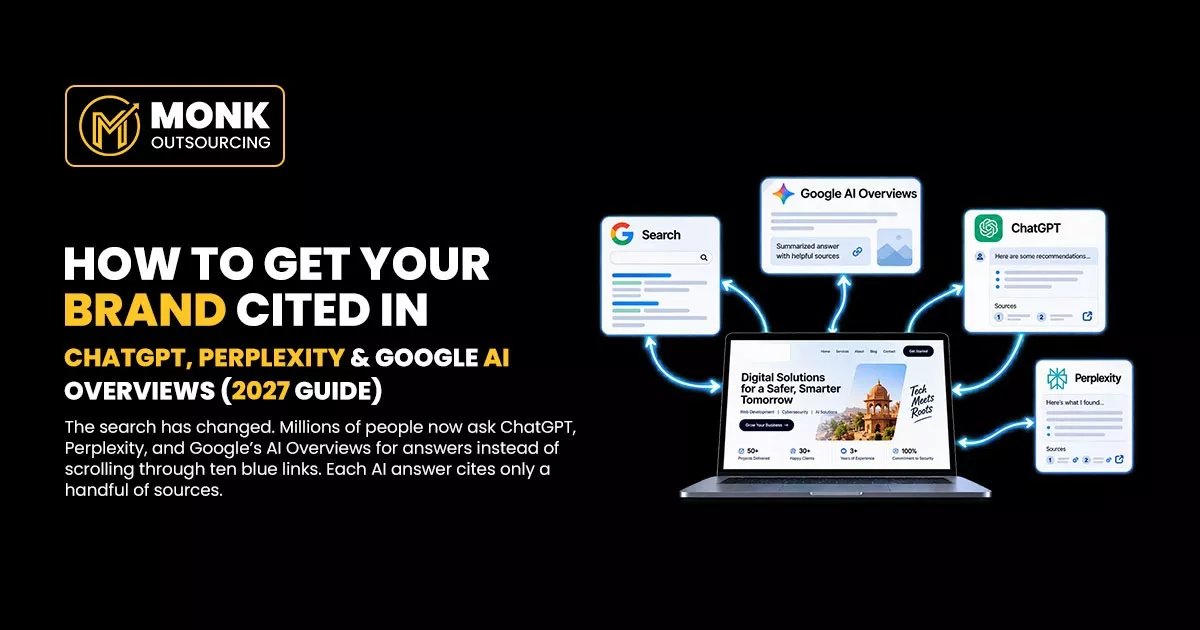
The search has changed. Millions of people now ask ChatGPT, Perplexity, and Google’s AI Overviews for answers instead of scrolling through ten blue links. Each AI answer cites only a handful of sources. If your brand is not one of them, you are invisible to that buyer, even if you rank on page one of Google.
The good news is that AI citations are not random. In this guide, we explain how to get your brand cited in AI search, step by step.
What Does It Mean to Get Cited in AI Search?
| User Prompt | Brand Mention | AI Citation |
|---|---|---|
| “Best SEO agencies for small businesses in Texas” | YourBrand is listed as a recommended agency, with no link. | yourbrand.com/local-seo appears as a linked source. |
| “What is GEO?” | YourBrand is not named in the answer. | The answer uses YourBrand’s GEO guide and links to it. |
Why Does AI Search Visibility Matter for Your Business?
- High-intent traffic—Users who click on a citation have already read a summary, so they arrive ready to act.
- Built-in trust—An AI recommendation works like a third-party endorsement.
- Zero-click visibility—Even without a click, users see your brand name.
How to Get Your Brand Cited in ChatGPT, Perplexity & Google AI Overviews: 8 Steps
Step 1 – Allow the right AI crawlers
| Crawler | What It Does | Allow for AI Search? |
|---|---|---|
| OAI-SearchBot | Shows and links pages in ChatGPT search | Yes |
| GPTBot (OpenAI) | Collects content for AI model training | Your choice |
| PerplexityBot | Shows and links pages in Perplexity answers | Yes |
| Googlebot | Crawls for Google Search, including AI Overviews | Yes |
Step 2 – Answer the question first
Step 3 – Structure content for easy extraction
Use short paragraphs, bullet points, numbered steps, and tables. Keep one main idea per section, so AI can lift it as a complete answer.
Step 4 – Use schema markup as a support signal
Organization, Article, Product and Local Business schema help search engines understand your content. But schema does not guarantee an AI citation. Google’s documentation on AI features says no special structured data is needed for AI Overviews, and any schema should match the visible page text.
Step 5 – Build trust signals (E-E-A-T)
Step 6 – Publish original data
AI tools love to cite unique facts. Share surveys, benchmarks, client results or expert insights that no one else has.
Step 7 – Earn relevant third-party mentions
Mentions alone do not make AI tools trust a brand. But relevant, authoritative third-party mentions can strengthen your brand’s visibility. Aim for industry roundups (like top AI marketing agencies lists), respected publications, guest posts, review sites and genuine community discussions on YouTube, Reddit and Quora that connect your brand to your topic.
Step 8 – Keep content fresh
What Is Entity Optimization for AI Search?
can recognize. When your brand details match everywhere, AI tools connect every mention back to you. Build a consistent identity across:
- Website—A detailed About page with your official name, services, location and leadership.
- Organization schema—Logo, contact details and sameAs links to your official profiles.
- LinkedIn and Google Business Profile—The same name, description, services, address and phone number. This also supports your local SEO.
- Directories and review sites—Identical, up-to-date listings on Clutch, G2, Crunchbase and Yelp.
- Author profiles—Bios linked to real LinkedIn profiles.
How Can You Track AI Citations and Brand Mentions?
Run a fixed set of 20–30 customer prompts in ChatGPT, Perplexity and Google every month, and track:
| What to Track | How to Track It |
|---|---|
| AI citations | Log every linked source for each prompt |
| Brand mentions | Note whether your brand is named in the answer text |
| Cited URLs | Record which of your pages get cited most |
| Competitor visibility | Log competitor mentions and calculates your share of voice |
| AI referral traffic | Check GA4 for chatgpt.com and perplexity.ai referrals |
| Branded search | Track branded impressions in Google Search Console |
AI answers vary between sessions, so use the same prompts each month. Tools such as Semrush can automate much of this at scale.
What Are the Biggest GEO Myths?
| Myth | Reality |
|---|---|
| An llms.txt file will get you cited | It is a proposed standard that major AI search engines have not confirmed they use. Google says no AI text files are needed. |
| FAQ schema guarantees citations | No schema guarantees a citation. Clear visible answers matter more. |
| Bulk AI-generated blogs boost visibility | Repetitive content gives AI no reason to cite you, and Google’s spam policies target scaled, low-value content. |
Is SEO Still Important for AI Search?
Yes. Google confirms there are no extra requirements for AI Overviews beyond being indexed and eligible for a snippet in Search. ChatGPT and Perplexity also rely on web search. If your site is not indexed and ranking, AI tools are unlikely to find it. That is why a strong SEO foundation, whatever it costs your business today, is still the starting point for AI search visibility.
Conclusion
AI search is not replacing SEO; it is raising the bar. Brands that get cited make their content easy to access, easy to extract and easy to trust. Ready to get your brand cited in AI search? Contact Monk Outsourcing today for expert SEO and GEO services.
FAQs
1. How do I get my brand mentioned in ChatGPT?
Allow OAI-SearchBot, answer common questions clearly on your pages and earn mentions on trusted third-party websites.
2. Can I pay to be cited in Google AI Overviews?
No. Citations in AI Overviews are organic. Ads may appear separately, but you cannot buy a citation.
3. How long does it take to get cited in AI search?
Timelines vary, and there is no guaranteed timeframe for AI citations. Results depend on your site’s authority, competition and how each platform selects sources. Some pages are cited within weeks, while others take months of consistent work.
4. Do I need an llms.txt file?
No. Google says AI text files are not needed, and major AI search engines have not confirmed they use llms.txt.
5. What is the difference between GEO and SEO?
SEO helps your pages rank in traditional search results. GEO helps your brand get cited and mentioned inside AI-generated answers. The best strategy combines both.